At the invitation of Trends in Endocrinology & Metabolism, Dr. AI Youwei from the Institute of Genetics and Developmental Biology (IGDB), Chinese Academy of Sciences, and Dr. HUANG Xun at IGDB and TaiKang Medical School, Wuhan University, co-authored a Spotlight article discussing the recent Molecular Cell research article, “mTORC1 activity suppresses ferroptosis through a SCARB1-dependent HDL-tocopherol uptake pathway.” The Spotlight was published online on June 26, 2026 (https://doi.org/10.1016/j.tem.2026.06.001).
Ferroptosis is a regulated form of cell death driven by oxidative imbalance and the accumulation of lipid peroxides in cellular membranes, ultimately compromising membrane integrity. Rapidly proliferating cancer cells rely on intense metabolic activity and are often exposed to substantial oxidative stress; pharmacologically inducing ferroptosis has therefore emerged as a promising anticancer strategy. Conversely, oxidative stress associated with tissue degeneration and injury, including ischemia-reperfusion injury, can promote pathological ferroptosis and worsen disease. Accordingly, ferroptosis inhibitors are being actively explored as interventions for oxidative tissue damage.
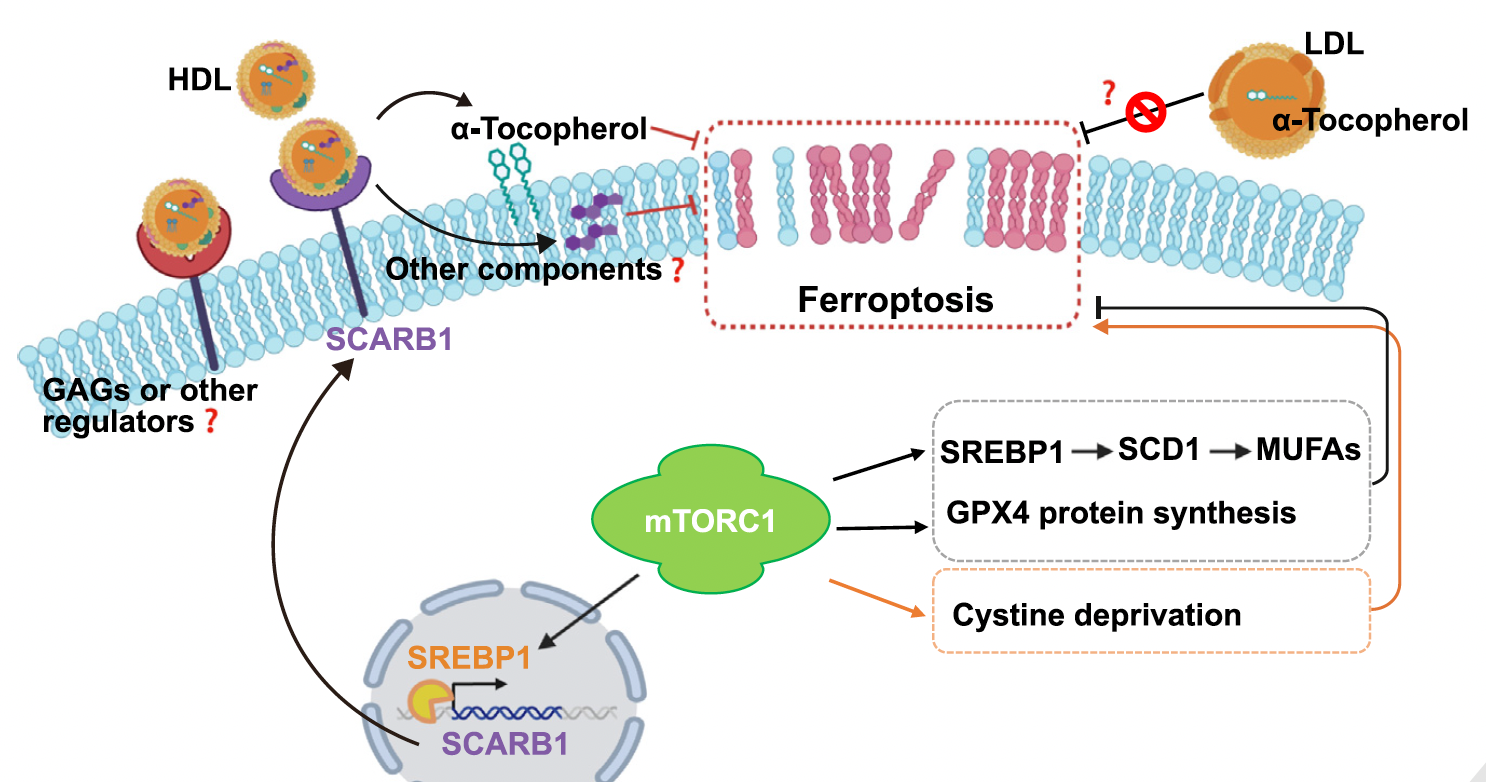
Lipophilic antioxidants and metabolites can suppress ferroptosis by quenching lipid radicals in cellular membranes. The highlighted study shows that high-density lipoprotein (HDL), a dynamic circulating component of the body, is taken up through the cell-surface receptor SCARB1, thereby delivering the lipophilic antioxidant α-tocopherol and protecting cells from ferroptosis. This process is controlled by mTORC1, a central regulator of cellular nutrient sensing and metabolism. Through SREBP1, mTORC1 increases SCARB1 expression, enhances HDL uptake, and strengthens ferroptosis resistance. Because both mTORC1 activity and HDL availability can vary with metabolic state and disease context, rational combinations of mTORC1 modulators with ferroptosis inducers or inhibitors may outperform monotherapy in selected settings.
mTORC1 promotes SCARB1 expression through SREBP1, enhancing HDL uptake and suppressing ferroptosis. (Image by IGDB)
Dr. Youwei Ai, Dr. Xun Huang, and Dr. Bo Yan of Tianjin Medical University, a visiting scholar in the Ai laboratory, are co-corresponding authors. This work was supported by several funding sources, including the National Natural Science Foundation of China Innovative Research Group project “Membrane Lipid Regulation and Disease.”
Contact:
Dr. AI Youwei
Institute of Genetics and Developmental Biology, Chinese Academy of Sciences
Email: aiyouwei@genetics.ac.cn
 CAS
CAS
 中文
中文



.png)
 mTORC1 promotes SCARB1 expression through SREBP1, enhancing HDL uptake and suppressing ferroptosis. (Image by IGDB)Dr. Youwei Ai, Dr. Xun Huang, and Dr. Bo Yan of Tianjin Medical University, a visiting scholar in the Ai laboratory, are co-corresponding authors. This work was supported by several funding sources, including the National Natural Science Foundation of China Innovative Research Group project “Membrane Lipid Regulation and Disease.”Contact:Dr. AI YouweiInstitute of Genetics and Developmental Biology, Chinese Academy of SciencesEmail: aiyouwei@genetics.ac.cn
