Wheat is one of the world’s most important staple crops, feeding billions of people and serving as a major source of food security in China. For Chinese consumers, wheat quality directly determines the texture and processing performance of staple foods such as steamed bread, noodles, and bread. With rising living standards and changing dietary preferences, public demand has shifted from simply “having enough to eat” toward “eating better.” As a result, China’s imports of high-quality wheat have increased steadily in recent years, reaching 13 million tons in 2023, accounting for nearly 10% of the country’s annual wheat production. How to improve wheat processing quality while maintaining high and stable yields has therefore become a critical challenge for modern agriculture and wheat breeding.
The key determinants of dough elasticity, extensibility, and other processing properties are gluten proteins stored in wheat grains. For decades, breeders have recognized the importance of several high-molecular-weight glutenin subunits for strong-gluten quality. However, the genes encoding gluten proteins are highly repetitive, structurally complex, and clustered within the wheat genome, making many important genomic regions difficult to fully resolve, almost like an unreadable “genetic code.” This limitation has hindered the systematic discovery of key quality-related variants, restricted understanding of the molecular and evolutionary basis of superior wheat quality, and slowed the development of efficient and precise breeding strategies.
On May 7, 2026, a research team led by LU Fei at the Institute of Genetics and Developmental Biology, Chinese Academy of Sciences, together with the team of CAO Xinyou at the Crop Research Institute, Shandong Academy of Agricultural Sciences, published a study in Nature Plants titled “A high-quality bread wheat genome unravels adaptive evolution of wheat end-use quality” (DOI: 10.1038/s41477-026-02288-7).
Using “Jimai 44,” one of the most widely cultivated strong-gluten wheat varieties in China, the researchers generated a high-quality reference genome that fully resolved the fine-scale structure of gluten protein loci. Combined with a whole-genome variation map from 485 wheat and related accessions, the study reconstructed the adaptive evolutionary history of wheat processing quality across domestication, polyploidization, Eurasian dissemination, and modern Chinese breeding. The work systematically revealed how strong-gluten wheat quality traits have evolved during breeding and adaptation.
Importantly, the study showed that wheat quality improvement is not simply driven by the accumulation of a few “favorable genes.” Instead, it is shaped by both highly variable gluten protein genes and extensive epistatic interaction networks among these genes.
The findings provide a new evolutionary perspective on how wheat has been shaped into a crop suitable for diverse food-processing purposes. The study also offers new directions for future breeding-by-design strategies: breeders should not only focus on traditional strong-gluten markers, but also further explore the trait-shaping potential of highly variable genes such as low-molecular-weight glutenins and gliadins, while incorporating combinational and epistatic effects among gluten genes into breeding programs.
Given the significance of the findings, Nature Plants also published a research briefing titled “The assembly of an elite bread wheat genome reveals how wheat end-use quality has evolved” to highlight the study.
This research was supported by the National Key Research and Development Program of China, the National Natural Science Foundation of China, the Taishan Scholars Program of Shandong Province, the China Agriculture Research System, and the Strategic Priority Research Program of the Chinese Academy of Sciences.
High-quality assembly and annotation of the JM44 genome (Image by IGDB)
Contact:
Prof. LU Fei
Institute of Genetics and Developmental Biology, Chinese Academy of Sciences
Email: flu@genetics.ac.cn
 CAS
CAS
 中文
中文



.png)
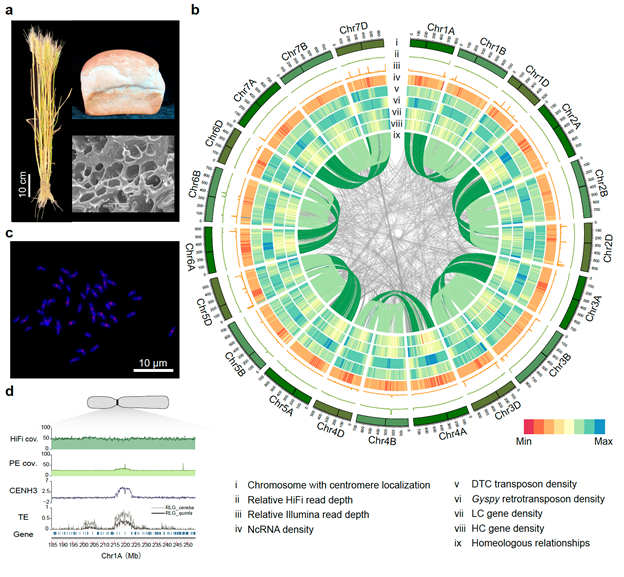 High-quality assembly and annotation of the JM44 genome (Image by IGDB)Contact:Prof. LU FeiInstitute of Genetics and Developmental Biology, Chinese Academy of SciencesEmail: flu@genetics.ac.cn
