Grain size influences grain yield and is a core agronomic trait for breeders. Although previous studies have shown that histone acetylation modifications can affect grain size, it has long been unclear how epigenetic mechanisms precisely target specific genes to regulate this trait.
Recently, a research team led by Prof. LI Yunhai from the Institute of Genetics and Developmental Biology of the Chinese Academy of Sciences (CAS), Prof. ZHENG Leiying from
the Institute of Botany of theCAS and Prof. DIAO Xianmin from the Institute of Crop Sciences of Chinese Academy of Agricultural Sciences, has revealed a novel epigenetic mechanism. They demonstrate that a complex formed by the histone-binding protein LARGE3 and the histone deacetylase OsHDT1 regulates grain size in rice by modulating histone H4 acetylation. Their findings are published in
The Plant Cell (https://doi.org/10.1093/plcell/koag109).
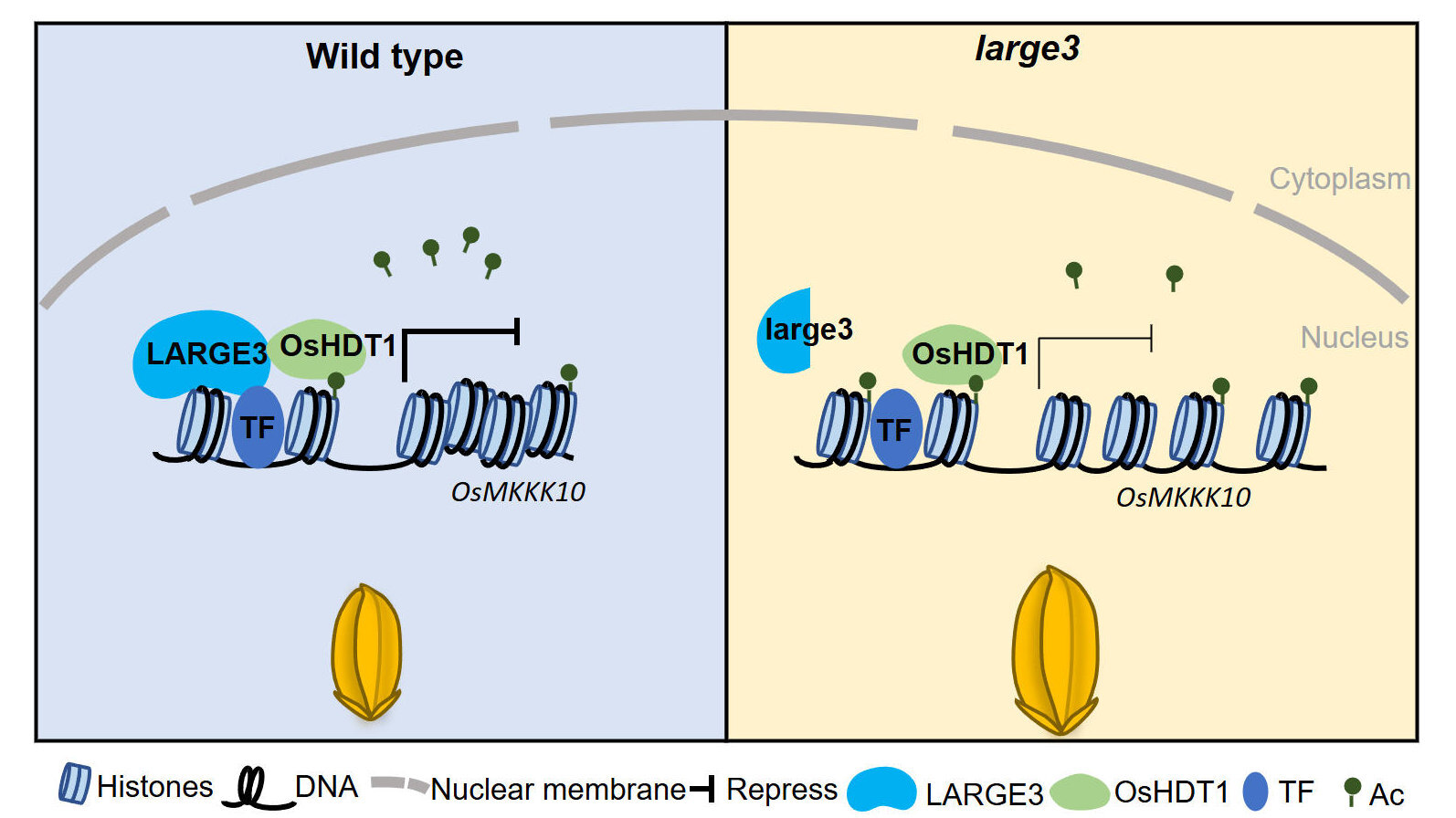
Screening a rice mutant population, the researchers identified large3-1 which produces significantly larger and heavier grains, and confirmed that the phenotype is caused by a mutation in the LARGE3 gene. Further analyses revealed that LARGE3 is a nuclear protein that binds histones and directly interacts with OsHDT1. Together, they repress expression of an important grain size gene OsMKKK10 by decreasing its histone H4 acetylation level and increasing its nucleosome density.
Importantly, genome editing of the LARGE3 homolog in foxtail millet forms large grains and can increase grain yield demonstrating that this module has the potential to improve the grain yield in key crops.
In summary, these findings establish a previously unrecognized link between epigenetic control of grain size and MAPK signaling. They not only reveal a mechanistic framework but also provide a new target for precision breeding.
Proposed working model for LARGE3 in grain size control (Image by IGDB)
Contact:
Prof. LI Yunhai
Institute of Genetics and Developmental Biology of the Chinese Academy of Sciences
Email: yhli@genetics.ac.cn
 CAS
CAS
 中文
中文



.png)
 Proposed working model for LARGE3 in grain size control (Image by IGDB)Contact:Prof. LI YunhaiInstitute of Genetics and Developmental Biology of the Chinese Academy of SciencesEmail: yhli@genetics.ac.cn
