August Weismann’s germ plasm theory posited that only germ cells transmit genetic information to the next generation, whereas somatic mutations represent an evolutionary dead end. Although this theory has been widely validated in animals, direct evidence in plants has been lacking. Plants adapt to environmental changes through developmental plasticity, which is enabled by the continuous growth of meristematic cells and the formation of new organs. This developmental framework contrasts with the rapid, early organ development commitment observed in animals. Since plants establish their reproductive organs relatively late, it is widely believed that germline segregation also occurs during flower formation. This idea challenges the applicability of Weismann’s germ plasm theory to plants.
In a recent study published in Current Biology, researchers from Dr. QIAN Wenfeng’s lab at the Institute of Genetics and Developmental Biology, Chinese Academy of Sciences, tested Weismann’s germ plasm theory in Arabidopsis.
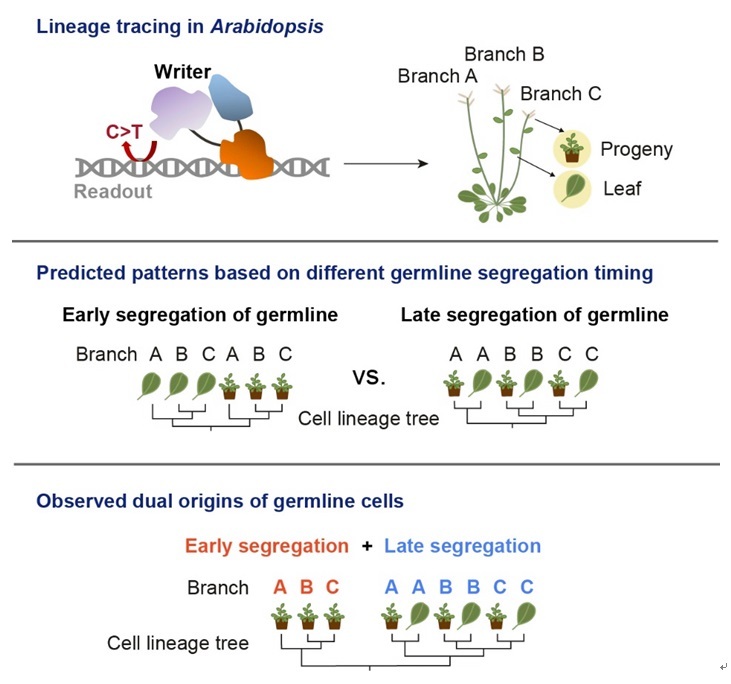
To address this, the researchers applied a dynamic editing-based lineage tracing system to record cell developmental trajectories in Arabidopsis. During cell division, the base editor AID (“writer”) continuously introduces heritable mutations into the synthetic DNA “readout” sequence, enabling the progressive accumulation of lineage information. Through deep sequencing, the researchers identified somatic mutations occurring in parental leaves as well as germline mutations transmitted to the progeny. The researchers then employed these mutations to reconstruct the cell lineage tree connecting somatic cells and germline cells in Arabidopsis.
Based on the cell lineage tree, the researchers discovered two distinct patterns of germline segregation in Arabidopsis: some germline cells segregate during inflorescence meristem formation (late segregation), while others segregate earlier than branch formation (early segregation)—providing experimental support for a plant counterpart to Weismann’s germ plasm theory. It reveals that germline segregation in Arabidopsis occurs earlier than previously recognized.
This research provides new insight into how plants balance developmental plasticity with safeguarding genetic integrity in their progeny, highlighting the role of meristem organization in limiting heritable mutations. It further deepens our understanding of plant development, environmental adaptation, and genomic evolution.
This study entitled “Testing Weismann’s Germ Plasm Theory in Arabidopsis” was published in Current Biology (https://doi.org/10.1016/j.cub.2026.03.003) on March 30, 2026. And it was supported by the Strategic Priority Research Program of the CAS, the Biological Breeding-National Science and Technology Major Project, and CAS Project for Young Scientists in Basic Research.
Lineage tracing in Arabidopsis reveals dual origins of germline cells
(Image by IGDB)
Contact:
Dr. QIAN Wenfeng
Institute of Genetics and Developmental Biology, Chinese Academy of Sciences
Email: wfqian@genetics.ac.cn
 CAS
CAS
 中文
中文



.png)
 Lineage tracing in Arabidopsis reveals dual origins of germline cells(Image by IGDB)Contact:Dr. QIAN WenfengInstitute of Genetics and Developmental Biology, Chinese Academy of SciencesEmail: wfqian@genetics.ac.cn